
Written by The Banking Post
Speakers at a recent dialogue emphasized the need for a fruitful and forward-looking diplomatic strategy in the days ahead. They noted that discussions and pacts with powerful countries have not always favored Bangladesh.
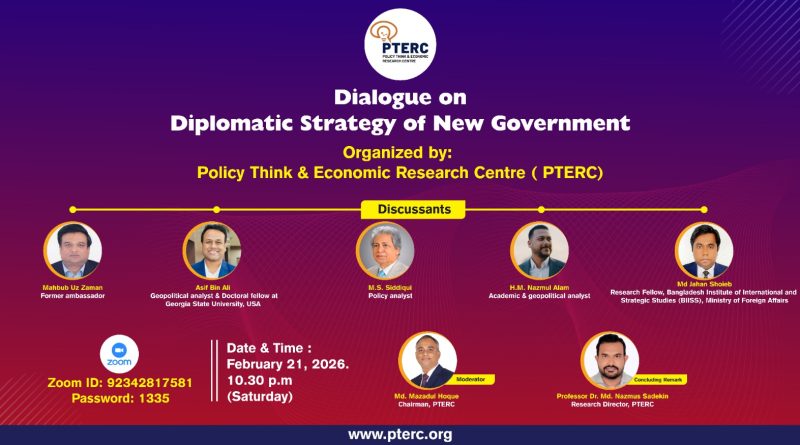
The observations were made at a program titled “Dialogue on Diplomatic Strategy of the New Government,” organized virtually by the Dhaka-based think tank Policy Think & Economic Research Centre (PTERC).
Former Ambassador Mahbub Uz Zaman said economic diplomacy must be emphasized in the current context. He stressed that relations with ASEAN member states and other major powers need to be strengthened. He also said the present government must develop an effective diplomatic strategy to address the Rohingya crisis.
Geopolitical analyst and doctoral fellow at Georgia State University, Asif Bin Ali, said that foreign policy must be business-focused. He noted that a high trade deficit weakens a country’s position in foreign policy. He added that tariff issues have increasingly become instruments of pressure. Bangladesh is likely to face challenging times in diplomatic affairs, and to tackle these problems, the Ministry of Foreign Affairs must operate with greater professionalism, he said.
Policy analyst M.S. Siddiqui said that many agreements or pacts related to diplomatic issues have not favored Bangladesh.
Academic and geopolitical analyst H.M. Nazmul Alam said that diplomatic strategies must be balanced to protect Bangladesh’s greater national interests.
A research fellow from the Bangladesh Institute of International and Strategic Studies (BIISS) said Bangladesh needs to further develop diplomatic relations with neighboring countries. He also emphasized that a diplomatic strategy focused on manpower export should be undertaken immediately.
PTERC Chairman Md. Mazadul Hoque moderated the dialogue, while PTERC Research Director Professor Dr. Nazmus Sadekin delivered the concluding remarks.