


Written by The Banking Post
Market experts and stakeholders have called for sweeping structural reforms to turn the stock market into a major source of long-term financing and reduce the economy’s heavy dependence on bank borrowing.
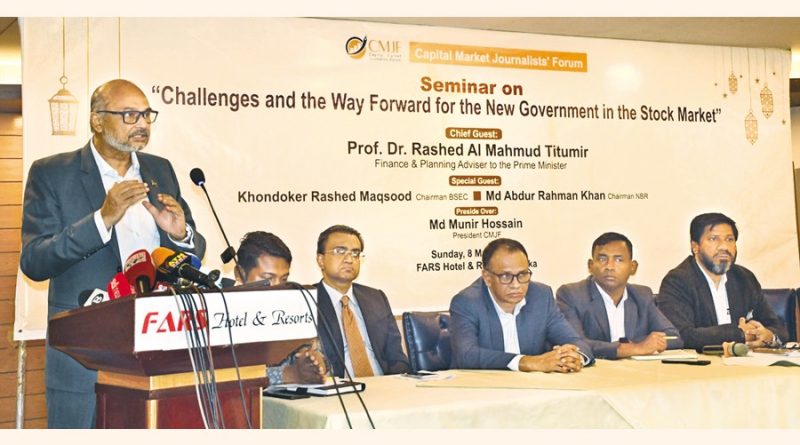
They made the call at a seminar titled “Challenges and Way Forward for the New Government in the Stock Market” held in the capital on Sunday. The event was organised by the Capital Market Journalists’ Forum.
Participants said a deeper, more transparent capital and bond market is essential to correct structural imbalances in the financial system and support sustainable economic growth.
Push for structural reforms
Speaking as the chief guest, Rashed Al Mahmud Titumir, finance and planning adviser to the prime minister, said the government is preparing structural reforms to expand market ownership, attract foreign investment and strengthen regulatory oversight.
He said authorities are considering launching a dedicated investment gateway for expatriate Bangladeshis to facilitate their participation in the domestic capital market.
The adviser also highlighted the potential to expand Islamic finance instruments to attract investors from Muslim-majority countries.
“Our economy cannot remain sustainable if it relies heavily on debt,” he said, adding that the government aims to build a $1 trillion economy by 2034.
He noted that stock market capitalisation currently stands at about 12 per cent of GDP—far below levels seen in neighbouring countries.
Authorities are also exploring the use of advanced information technology and blockchain systems to enhance transparency and security in market operations, he added.
Titumir said the government plans to promote ownership-based industrialisation to reduce dependence on debt financing, with several reform measures expected to be included in the upcoming national budget.
He also stressed the need for stronger accountability among auditors, asset valuation firms and credit rating agencies, whose reports significantly influence investor decisions.
“If those reports misrepresent a company’s financial condition, it undermines trust in the entire market,” he said, adding that regulatory institutions such as the finance ministry, the Financial Reporting Council and the Bangladesh Securities and Exchange Commission would be strengthened.
Enforcement and regulatory challenges
BSEC Chairman Khondoker Rashed Maqsood said the regulator has intensified enforcement over the past 18 months.
He noted that the commission carried out 126 investigations during the period and imposed fines totalling Tk 14.88 billion (about $136 million). However, only Tk 52.3 million has so far been recovered as some cases remain under legal proceedings.
National Board of Revenue Chairman Abdur Rahman Khan said weak enforcement of existing regulations—not tax policy—is the main obstacle to developing the capital market.
“We have many laws, but they are not implemented,” he said, adding that tax incentives introduced after previous market crashes did not significantly improve market performance.
“Tax incentives alone cannot guarantee a healthy market,” he said, noting that companies unable to pay dividends would not be allowed to list in the future.
Stakeholders flag market constraints
Md Moniruzzaman, senior vice president of the DSE Brokers Association of Bangladesh, said Bangladesh’s financial system faces three key challenges—stock market liquidity shortages, pressure on the banking sector and weak tax collection.
Dhaka Stock Exchange Chairman Mominul Islam said the capital market received little policy attention over the past 15 years, though the current government has begun focusing more on its development.
Chittagong Stock Exchange Chairman AKM Habibur Rahman said a strong stock market depends on a stable banking system, a stable economy and the rule of law.
Sumit Podder, secretary general of the Bangladesh Merchant Bankers Association, said no new company has entered the stock market in the past two years and called for incentives to attract quality initial public offerings.
The seminar was chaired by CMJF President Md Munir Hossain and moderated by its general secretary Ahsan Habib.


