
Written by The Banking Post
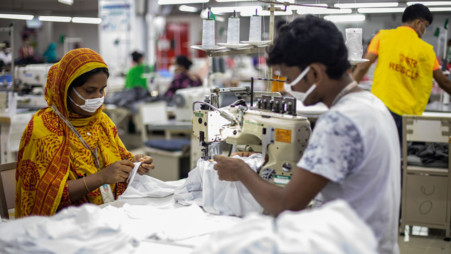
Nearly all export-oriented garment factories have paid February wages and Eid allowances, easing concerns over worker payments ahead of the festival, according to the Bangladesh Garment Manufacturers and Exporters Association (BGMEA).
BGMEA President Mahmud Hasan Khan said about 99.91 per cent of factories have cleared February wages, with only two units still in the process. Around 99.81 per cent have paid Eid festival allowances, while four factories are yet to complete disbursement.
Despite no legal requirement, around 64 per cent of factories have also paid partial advance wages for March.
The sector—Bangladesh’s largest export earner—has been under pressure from a global economic slowdown, rising competition and higher production costs. In the first eight months of FY2025-26, garment export earnings fell 3.73 per cent, while back-to-back letters of credit for raw material imports dropped 6.79 per cent. Average unit prices also declined.
Manufacturers are grappling with rising energy costs and financial constraints. Gas prices have surged sharply over the past five years, electricity tariffs have increased, while high interest rates and liquidity shortages have tightened working capital.
The BGMEA president said coordinated efforts by factory owners, banks, labour groups and government support—including Tk 25 billion in cash and concessional loans—helped factories clear dues despite financial stress.
To ease Eid travel congestion, factories are staggering holiday schedules by region. About half began holidays earlier this week, with the rest set to follow shortly.
However, data from the Industrial Police show that some workers are still awaiting payments outside the core RMG segment.
As of Wednesday, about 92.7 per cent of 10,100 industrial units under its supervision had paid February wages, while 8,440 factories—around 83.5 per cent—disbursed festival allowances.
Compliance was highest in export processing zones, where all factories under Bangladesh Export Processing Zones Authority cleared both wages and bonuses.
A senior Industrial Police official said the number of factories with pending payments declined through the day, with only a small number left by evening and most expected to settle dues shortly.
There were no major labour unrest incidents, barring an isolated protest triggered by delayed payments, which was later resolved after the factory owner arranged funds.
Labour leaders, however, alleged irregularities in non-RMG sectors, particularly in Ashulia and Gazipur, where some factories failed to pay wages and bonuses on time.
“Timely payment of wages and festival bonuses is a legal obligation. Failure to do so violates labour rights,” a labour leader said, urging stricter action against non-compliant factories.
Concerns over job security also surfaced, with reports of worker layoffs in some factories ahead of Eid. Responding to the issue, the BGMEA president said any termination must follow legal procedures and ensure full compensation and benefits for affected workers.