
Written by The Banking Post
Stocks on the Dhaka Stock Exchange surged on Sunday, with the benchmark index climbing to a nearly 10-month high, as investors responded positively to budgetary incentives and reform measures aimed at revitalising the capital market.
The rally came after Finance Minister Amir Khosru Mahmud Chowdhury unveiled a series of policy measures in the proposed budget to support private-sector growth and strengthen long-term capital market development.
The market maintained a strong upward trajectory throughout the session, supported by rising buying interest in blue-chip stocks.
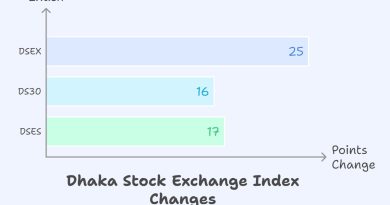
The DSEX, the benchmark index of the DSE, jumped 105 points, or 1.90 percent, to close at 5,625, crossing the 5,600-point mark for the first time in nearly 10 months.
Market analysts said the rally was driven by a combination of fiscal incentives, tax relief and regulatory reform initiatives aimed at improving corporate profitability, boosting liquidity and attracting long-term investment.
Among the key proposals welcomed by investors were the conversion of tax deducted at source (TDS) into an advance tax, cuts in withholding tax on several business inputs, simplified listing procedures and measures to strengthen market governance.
Banks, telecom operators, pharmaceutical companies, fuel distributors, power producers, electronics manufacturers and automobile firms are expected to benefit the most from the proposed measures.
The budget also proposed allowing foreign investors to repatriate profits and transfer proceeds from shares purchased through non-resident investor taka accounts within one working day, a move expected to improve foreign participation in the market.
Market sentiment was further strengthened by expectations surrounding reforms under the newly formed Bangladesh Securities and Exchange Commission, with investors anticipating better transparency, fair pricing and stronger governance.
Global sentiment also improved after the announcement of a ceasefire in the Middle East, reducing external uncertainty and encouraging investors to accumulate beaten-down stocks.
In another major development, Bangladesh Bank provided Tk 25 billion in special liquidity support to Islami Bank Bangladesh PLC to help the country’s largest Shariah-based bank overcome an acute cash shortage.
Following the news, Islami Bank’s stock surged 9.97 percent to Tk 32 per share after suffering sharp declines since the removal of the floor price. The stock alone contributed 18.3 points to the benchmark index.
The FY27 budget also proposed strengthening the capital market as an alternative financing source through easier listing, development of alternative investment instruments and gradual shortening of the trade settlement cycle.
Broad-based gains were visible across the market. Of the 392 issues traded, 246 advanced, 96 declined, and 50 remained unchanged.
The DS30 index, which tracks blue-chip stocks, rose 47 points to 2,120, while the DSES index, representing Shariah-based stocks, gained 14 points to 1,129.
Turnover on the DSE rose to Tk 13.58 billion, up 10 percent from the previous session, reflecting stronger participation across banking, financial, engineering and pharmaceutical sectors.
Sector-wise, non-bank financial institutions led gains with a 4.4 percent rise, followed by banking, power, food, pharmaceuticals, engineering and telecom.
The Chittagong Stock Exchange also ended higher, with its CASPI rising 147 points to 15,343, while the CSCX advanced 91 points to 9,411.