


Written by The Banking Post
In a country where humanitarian work is often confined to quiet corners, Muhammad Raj has become one of Bangladesh’s most visible voices for people caught in conflict and crisis. Born and raised in a respected Brahmin family, he embraced Islam after a long period of personal reflection, and that decision reshaped the entire course of his life. Today he is known across the country not by the privileges of his birth, but by the relief work he leads in Gaza, Sudan and the most neglected districts of Bangladesh.
Raj serves as the Director General of the Hafezzi Charitable Society of Bangladesh (HCSB), a government registered national humanitarian organisation, and as Director of International Humanitarian Affairs at the SAARC Human Rights Foundation. Under his leadership, an organisation that began on a modest scale has grown into a recognised name in international relief, with field engagement that now stretches across the Middle East, Africa and South Asia.
His path to this work did not start in conference halls or diplomatic missions. By his own account, it began in struggle and faith. After his conversion, he faced trials that tested both his resolve and his social standing, and those years shaped a worldview built around empathy, dignity and service. He describes his humanitarian work not as a profession but as a moral responsibility, a duty owed to people whose suffering rarely reaches the front pages.
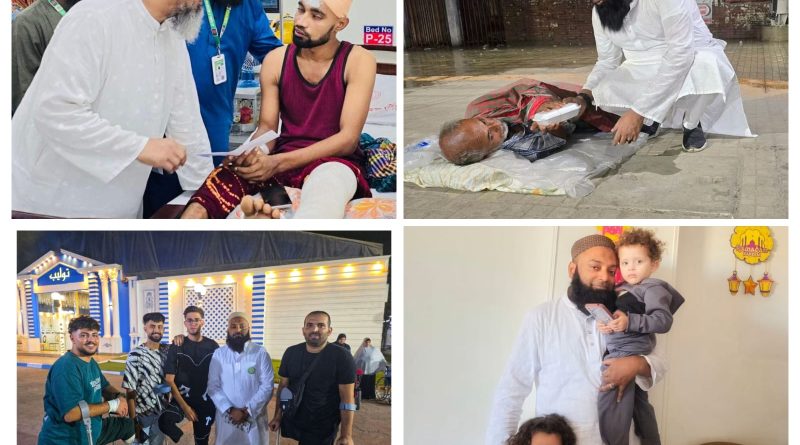
That conviction has carried him repeatedly into difficult terrain. Through HCSB, Raj has coordinated direct assistance for Palestinians displaced by the war in Gaza, including families sheltering in refugee camps in Egypt, and has overseen emergency support for communities affected by conflict and famine in Sudan. The organisation has reported delivering food, clean water, medical care, winter clothing and financial support to thousands of affected families, channelled through volunteer teams on the ground. Raj has personally travelled to Egypt on multiple occasions to supervise these operations and to ensure that aid reaches the most vulnerable households rather than stopping at administrative checkpoints.
At home, the work is no less varied. HCSB conducts free medical camps in remote and hill tract areas, supports treatment for underprivileged patients, installs tube wells, establishes maktabs and schools, distributes winter clothing, and runs Ramadan food markets and Eid relief for families living on the margins. The organisation also carries forward initiatives for new Muslims and for unemployed youth, framing each programme around the restoration of dignity rather than charity alone.
Raj’s contributions have drawn formal recognition at home and abroad. He has been honoured with the International Peace Award 2024 in Bangladesh, received an award presented through the Bangladesh mission in Cairo in 2024, and was conferred the Nepal Bangladesh International Excellence Award in Kathmandu. Beyond these honours, his humanitarian engagement and his writing have featured in a wide range of national newspapers and magazines, and he is himself a regular contributor of articles on humanitarian and social themes.
His public reach is striking. Across his official platforms, Raj commands a following of roughly two million people, making him one of the most widely followed humanitarian figures in Bangladesh’s digital space. He has used that platform to keep the crises in Gaza and Sudan in front of a domestic audience, and to mobilise ordinary citizens behind relief efforts that might otherwise pass unnoticed.
Throughout, Raj has remained closely tied to the country’s senior religious scholarship. He operates under the guidance of prominent Islamic scholars, and HCSB functions within a framework of religious and ethical accountability. Leading scholars of the country are known to hold him in regard, a standing that has lent the organisation both trust and reach among the wider public.
Despite his growing international visibility, those who know him describe a deliberately low profile personal approach. “I accepted Islam to seek the pleasure of the Almighty, not recognition,” he has said of his work, adding that the members of his organisation seek their reward only from God.
As the humanitarian emergencies in Gaza and Sudan deepen, Raj continues to expand HCSB’s field engagement, planning further missions abroad to strengthen direct delivery of aid. His journey, from a privileged household to the dust of refugee corridors, has already become a notable chapter in Bangladesh’s quiet record of humanitarian leadership. For a growing number of admirers, the hope is that the country will one day honour him with the recognition they believe his service deserves.