
Written by The Banking Post
Dhaka – ActionAid Bangladesh; July 28, 2025:
The decline in foreign aid in Bangladesh’s development sector has become a major challenge for programs aimed at improving the lives of marginalized communities. This situation serves as a wake-up call. It is now time to take the lead through local innovation, diversify the economy, and utilize domestic resources. Sustainable progress requires self-reliance, strong institutions, and inclusive partnerships based on justice, dignity, and national ownership—not just dependency—among the government, private sector, development organizations, and civil society actors.
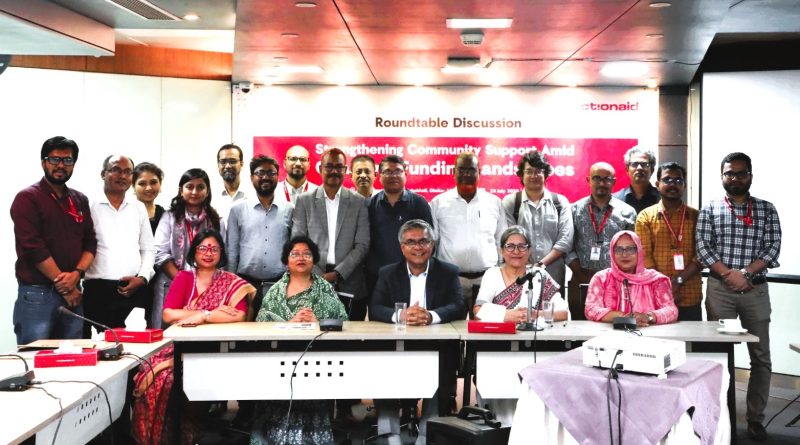
This call was made at a roundtable discussion held today (Monday, July 28) at the BRAC Centre Inn in Mohakhali, Dhaka. The meeting, titled “Strengthening Community Support Amid Changing Development Finance Landscape,” was organized by ActionAid Bangladesh.
The event brought together representatives from government ministries, various civil society organizations (CSOs), national and international development agencies, private sector stakeholders, climate and environmental experts, policy analysts, and researchers.
Key Discussion Points
Speakers highlighted the changing nature of development finance, the impacts of reduced foreign aid, and the need for government support in enabling CSOs to contribute to sustainable development.
Experts emphasized the importance of re-evaluating the role of CSOs, adopting strategic approaches, and exploring alternative sustainable financing models to tackle this evolving crisis.
Farah Kabir, Country Director of ActionAid Bangladesh, moderated the discussion. She stated:
“Due to shifts in global financing, our communities—especially women and children—are facing severe setbacks. The effects are already visible in the Rohingya camps. We must now leverage our own resources instead of relying on foreign aid. Through crowdsourcing, expansion of CSR, South-South cooperation, and digital advocacy, we can strengthen communities. Let us work collectively to create alternative pathways that secure their future.”
KAM Morshed, Senior Director at BRAC, emphasized the urgency of building domestic funding mechanisms in response to changing fund flows. He added that CSOs must prove their relevance and impact to rebuild trust with both communities and the government. He called for government coordination, the use of AI, and aligning CSO outcomes with national development goals.
He further urged tax exemptions on grants, reduced bureaucratic hurdles in public-private partnerships (PPP), and reform in fundraising policies for smaller NGOs. He asserted that CSOs should evolve from microfinance providers to credible development partners to bring about systemic change.
S.M. Monjurul Hannan Khan, Executive Director of Nature Conservation Management, noted that most civil society organizations lack the institutional capacity to access climate funds such as the Green Climate Fund (GCF).
He pointed out the Environment Department’s minimal budget (only 0.38%) and weak coordination between CSOs and the government. Stronger collaboration and community representation are crucial.
Dr. Khondaker Golam Moazzem, Research Director at the Centre for Policy Dialogue (CPD), said that CSOs have clear opportunities to engage in the government’s “Smooth Transition Strategy” as Bangladesh graduates from LDC status.
To ensure relevance and sustainability, he emphasized the need for domestic resource mobilization, closing tax gaps, engaging institutions like ERD, reducing unnecessary expenditure, avoiding duplication, and adopting tech-driven humanitarian practices.
Md. Aminul Islam, Senior Assistant Secretary at the Ministry of Foreign Affairs, noted the need to review existing funding models and clearly define capacity development within the global context. He urged CSOs to move away from short-term aid dependency and adopt sustainable business models aligned with global trends.
Zakir Hossain Khan, Executive Director of Change Initiative, observed that climate financing is shrinking ODA (Official Development Assistance). However, the recent ICJ (International Court of Justice) ruling has opened new doors. He urged pressuring major emitters for carbon taxes, redefining aid models to include nature-friendly grants, and strengthening citizen-community oversight.
Syeda Nasrin Parvin, Assistant Director of the Department of Women Affairs, stressed the need for government–NGO collaboration, although she acknowledged that corruption within government systems is a major obstacle. She stated that equipping NGOs with the necessary tools and allowing them to use surplus resources could significantly improve their effectiveness.
The roundtable concluded with remarks from Ibrahim Khalil Al-Zayyad, Chairperson of ActionAid International Bangladesh Society, who said:
“Funding is at the core of our work, and self-reliance is critically important. He called on the government to offer tax exemptions on grants and empower the Ministry of Foreign Affairs to officially recognize diaspora donations.
He noted that due to policy gaps, $7 billion worth of Zakat funds remain unused. To reduce donor dependency, we need blended finance, corporate partnerships, and inclusive, feminist leadership.”
Strategic Recommendations for Government-CSO Cooperation
Speakers offered several policy recommendations to improve government collaboration with CSOs:
- Mandatory CSR policies or incentive structures for large corporations
- Investments in financial management and impact evaluation training to enhance NGO capacity
- Development of a transparent and implementable Public-Private Partnership (PPP) framework