
Written by The Banking Post
Economists and business leaders have cautiously welcomed the government’s decision to bring in two renowned foreign companies to develop and operate the Laldia and Pangaon port terminals, saying the move could significantly enhance Bangladesh’s port capacity and efficiency. But they also urged the authorities to disclose the terms of the agreements to avoid questions over transparency.
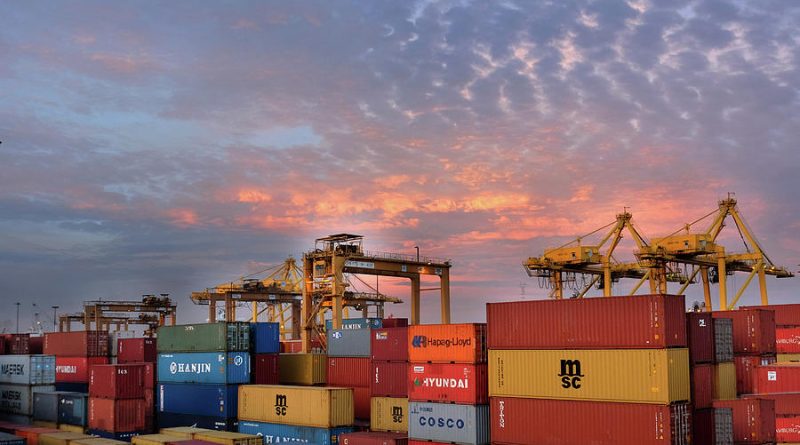
On 17 November, the Chittagong Port Authority (CPA) signed two major deals—one with Denmark’s APM Terminals to develop and operate the Laldia Container Terminal under a 30-year public-private partnership, and another with Switzerland-based Medlog SA to manage the Pangaon Inland Container Terminal under a 22-year concession. APM Terminals will invest $550 million in Laldia, while Medlog’s plan aims to modernise Pangaon and expand its capacity to 160,000 TEUs annually.
Industry leaders say bringing in world-class operators will reduce logistical bottlenecks and introduce global best practices to the country’s ports. Mohammad Hatem, managing director of MB Knit Fashion and president of BKMEA, said there was “no alternative” to involving top-tier companies if Bangladesh wants to cut lead time and improve cargo handling up to the standards of Shanghai, Singapore and Colombo.
Former CPD fellow Mustafizur Rahman said Bangladesh must scale up port capacity to face the challenges of the global tariff environment and the post-LDC graduation era. Investment—local or foreign—is essential, he noted. However, he said transparency would have prevented concerns over the deals.
Former World Bank lead economist Zahid Hussain called it a positive sign that Bangladesh could attract reputable international operators. He said the deals could help overcome long-standing inefficiencies and corruption that have plagued port operations. Knowledge transfer to local operators and workers would be a major gain, he added, though he also urged the government to publicly disclose non-confidential parts of the agreements.
Former BGMEA president Faruque Hassan also welcomed the move, saying foreign operators would bring advanced technology, strengthen trade flows and open up new avenues for knowledge sharing.
The Laldia project—first approved in 2013 but stalled for years due to land and procedural delays—was revitalised in 2024 after the government appointed IFC as its transaction adviser. Under the new agreement, APM Terminals will design, finance, build and operate the facility for 30 years, with a possible 15-year extension. Once operational in 2030, the terminal will add more than 800,000 TEUs of annual capacity and allow Chattogram port to handle vessels up to 6,000 TEUs, more than double the current limit. This is expected to reduce congestion, cut logistics costs and support export-driven sectors such as textiles and manufacturing.
Pangaon, Bangladesh’s first inland container terminal, was originally conceived in the early 1990s and inaugurated in 2013. The new agreement with Medlog aims to boost its throughput and better link inland logistics with seaports.
After the deal-signing ceremony in Dhaka, CPA Chairman Rear Admiral SM Moniruzzaman said cargo volumes are growing 11% annually and the country will need to handle an additional 1.5 million TEUs by 2030. “We urgently need both capacity and efficiency,” he said.
Robert Maersk Uggla, chairman of AP Moller-Maersk, described the Laldia project as “a gateway to Bangladesh’s next era of trade growth and prosperity.” APM Terminals will complete construction within three years and run the facility round-the-clock, creating 500–700 direct jobs and thousands more indirectly.
Despite the optimism, several organisations have protested the decision to lease key port operations to foreign firms, arguing for greater public scrutiny and openness from the government.