
Written by The Banking Post
The government has begun revising Bangladesh’s GDP data, alleging that previous administrations overstated growth and economic size for political purposes.
Finance and Planning Adviser Rashed Al Mahmud Titumir said the interim administration is working to correct long-standing distortions in official statistics as part of broader economic reforms.
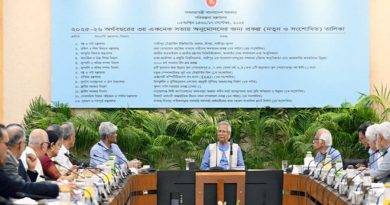
“We have already started reforming the way past governments politically exaggerated GDP growth rates and the overall size of GDP,” he said after a meeting at the National Board of Revenue.
Citing findings from a recent review, he alleged that economic data had been manipulated across multiple sectors, including revenue reporting.
“Once we determine the real size of GDP, the tax-to-GDP ratio will also become more realistic,” he said.
The adviser also pointed to discrepancies between reported and actual revenue figures, saying these could be verified through the government’s financial management system.
Highlighting the broader challenge, he said the government has inherited a strained economy marked by weak revenue mobilisation and external pressures.
“Bangladesh’s economy has collapsed—there is no point denying that. We have inherited a devastated economy,” he said, adding that the tax-to-GDP ratio remains below 7 per cent, among the lowest globally.
He warned that ongoing geopolitical tensions in West Asia are adding further strain, compounding existing macroeconomic challenges.
Despite the difficulties, the government is aiming to improve revenue performance in the coming months.
“Over the next three months, we hope to achieve a larger portion of the target in the fourth quarter,” he said.
The administration also plans to gradually raise the tax-to-GDP ratio to 10 per cent in the near term and 15 per cent by 2035 as part of its long-term fiscal strategy.