
Written by The Banking Post
Negative margin accounts held by capital market subsidiaries of non-bank financial institutions (NBFIs) facing liquidation could create fresh pressure on the stock market unless handled through a structured liquidation process, market experts warned.
The concern follows Bangladesh Bank’s move to liquidate nine NBFIs—one of them unlisted—which together own five brokerage houses and four merchant banks. Several of these subsidiaries have built up large negative equity after clients failed to repay margin loans, leaving securities in those accounts exposed to liquidation.
Industry insiders said that if subsidiaries are fully owned by the parent NBFIs, their assets and liabilities would be absorbed into the parent’s liquidation process. A direct sell-off of shares from negative margin accounts on the main board, however, could trigger sharp market pressure.
“It is not necessary that securities in negative margin accounts must be offloaded directly through the exchanges,” said Md Ashequr Rahman, managing director of Midway Securities. “Liquidators can auction assets or sell them through negotiated deals on the block board to maximise value.”
He noted that many negative margin accounts still hold shares of fundamentally strong companies, which could attract buyers at discounted prices through off-market transactions.
Bangladesh Securities and Exchange Commission (BSEC) Commissioner Md Saifuddin said a liquidator or administrator would be appointed to complete the process, adding that liquidation decisions are being executed by the central bank under existing laws and government approval.
However, uncertainty persists among affected firms. Md Rezaul Haque, managing director of Prime Finance Capital Management, said subsidiaries remain unclear about their fate as discussions over parent company liquidation continue. “We still don’t know what’s waiting for us,” he said.
Some market participants criticised the limited role of the securities regulator, arguing that investor protection demands stronger oversight. While the central bank regulates banks and NBFIs, their brokerage and merchant banking subsidiaries are licensed by the BSEC.
Rahman argued that liquidation of subsidiaries cannot proceed without licence cancellation by the securities regulator, and that there is scope for acquisitions by third parties rather than outright closures.
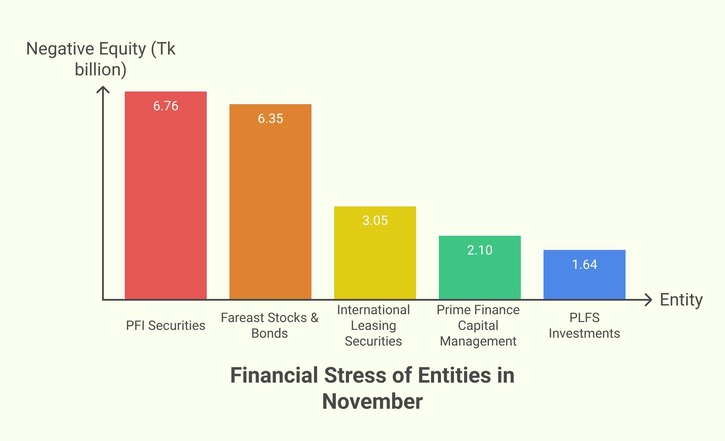
Data from the BSEC show deep financial stress across several entities: PFI Securities posted negative equity of Tk 6.76 billion, Fareast Stocks & Bonds Tk 6.35 billion, International Leasing Securities Tk 3.05 billion, Prime Finance Capital Management Tk 2.10 billion, and PLFS Investments Tk 1.64 billion as of November last year.
Aviva Finance, the only non-listed NBFI among the nine, owns 51% of Aviva Equity Management. Its chief executive officer Mohammed Shahidul Islam said regulators had extended deadlines for resolving negative equity in brokerages and merchant banks to 2030 or later, even as the central bank moves to liquidate parent companies.
“This puts us in a confounding situation,” he said. “If liquidation forces the settlement of negative equity, the market will inevitably face selling pressure.”
Experts say the way these assets are unwound—through orderly liquidation rather than fire sales—will be critical to protecting investors and maintaining stability in the equity market.