
Written by The Banking Post
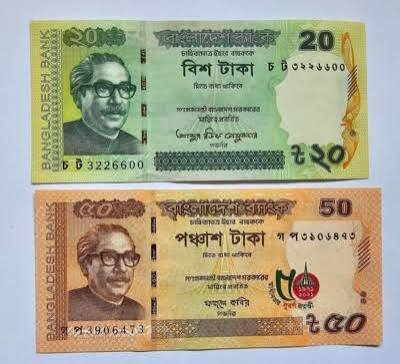
Newly designed Tk20 and Tk50 banknotes are expected to enter circulation next week as Bangladesh continues to face a shortage of fresh currency, leaving many worn-out and torn notes in use.
The Tk100 note, however, will be reissued with its existing design, Bangladesh Bank spokesperson Arief Hossain Khan said.
The new notes were initially scheduled for release this week, but security arrangements for their transportation could not be ensured amid garment workers’ protests in Gazipur, delaying distribution, a central bank official said.
Arief, also an executive director of Bangladesh Bank, said printing of the Tk20 and Tk50 notes had been completed. The Security Printing Corporation is expected to deliver the notes to the central bank by next week, after which they will be distributed to commercial banks.
The release will begin once the necessary security and transportation arrangements are in place.
The central bank is also encouraging greater use of digital payments through Bangla QR to reduce reliance on small-denomination cash and help curb irregularities and corruption, Arief said.
How banknotes are printed
Bangladesh Bank issues Tk10, Tk20, Tk50, Tk100, Tk200, Tk500 and Tk1,000 notes bearing the central bank governor’s signature. Tk1, Tk2 and Tk5 notes, along with coins, are government-issued currency and carry the finance secretary’s signature, although the central bank prints both categories.
Central bank data show that reserve money stood at slightly over Tk4.76 lakh crore in June. Of this, around Tk3.36 lakh crore was held by the public, with the remainder kept in banks.
Under the Bangladesh Bank Order, the central bank has the authority to issue currency. Banknote designs also require approval from the prime minister, according to central bank sources.
Bangladesh Bank invites international tenders at the beginning of each year to procure materials needed for printing currency, including security paper, specialised intaglio ink, security threads and chemicals. Almost all these materials are imported.
Eight companies from France, the UK, Germany, Switzerland, the Netherlands, Spain, Italy and Indonesia are currently enlisted as suppliers. Once the materials arrive, printing takes around three months because of the limited production capacity of the state-owned Security Printing Corporation (Bangladesh) Ltd.
Why the shortage persists
Before the fall of the Awami League government on 5 August 2024, banknotes carried the portrait of Sheikh Mujibur Rahman. Following the change of government, printing of notes bearing the previous design was stopped, and Bangladesh Bank halted the release of its remaining stocks.
Developing new designs, securing approval and starting production took considerable time, creating a shortage that has yet to be fully resolved. Although new notes are now being introduced, supplies remain below market demand.