
Written by The Banking Post
- 4,195 pieces of misinformation identified, 30 percent more than the previous year
- 2,281 political misinformation items, including 309 election-related ones
- 464 false claims involving the interim government; Dr Yunus targeted by 212 false claims
- More misinformation in favor of the Awami League, and against BNP–Jamaat–NCP
- 219 false claims involving the army, 133 involving the police
- The Osman Hadi murder issue saw the highest volume of misinformation
- Use of AI deepfakes increased by 409 percent
- Use of fake media photocards increased by 47 percent
Amid shifting political equations and unfolding events ahead of the 13th National Parliamentary Election, 2025 came to an end. Bangladesh’s fact-checking organization Rumor Scanner identified a record 4,195 pieces of misinformation last year. In the previous year, 2024, the number stood at 2,919. Within one year, Rumor Scanner observed an increase of nearly 30 percent in misinformation.
Instagram joins Facebook as a growing concern
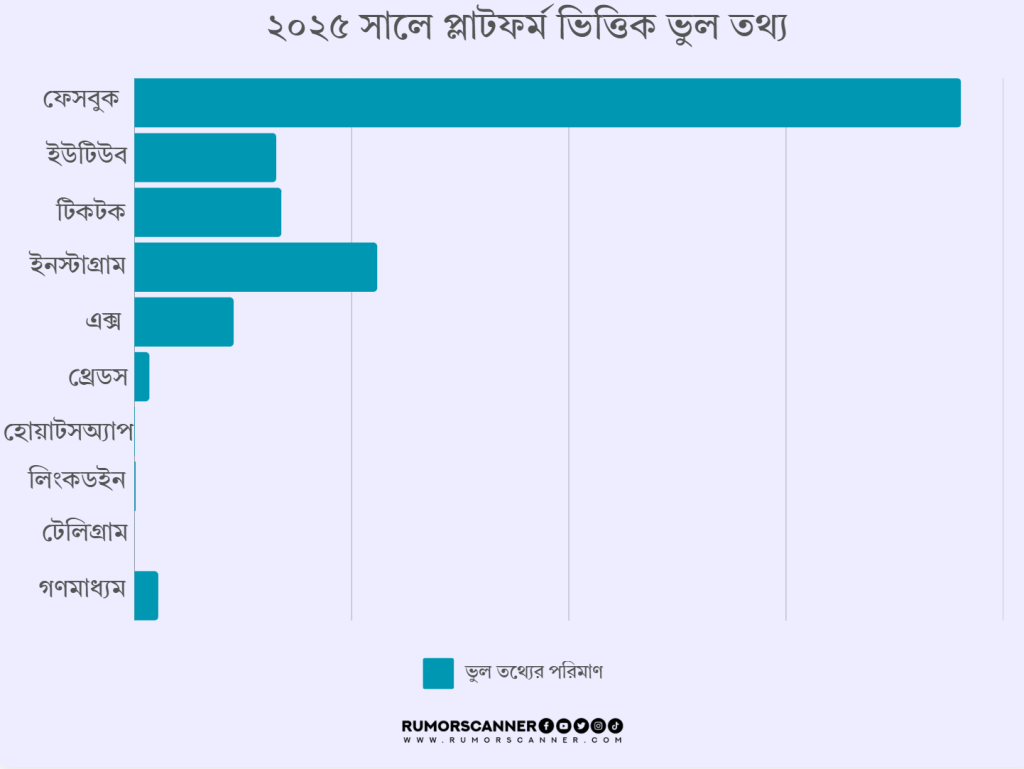
In 2025, 3,806 pieces of misinformation were identified on Facebook alone. On average, more than 10 false claims per day were circulated on this platform. After Facebook, Instagram emerged as the single platform spreading the second-highest amount of misinformation (1,118 items). Over the year, misinformation spread on TikTok and YouTube amounted to 677 and 653 items respectively. A significant volume of misinformation about Bangladesh was also circulated on X, where Rumor Scanner published reports on 457 such cases.
Beyond social media, mainstream media also played a role in spreading misinformation. Last year, 110 instances of misinformation were identified in reports published by national media outlets.
Political misinformation dominated the pre-election year
The country’s 13th National Parliamentary Election is scheduled for 12 February. Centering on the election, Rumor Scanner identified 309 false claims last year. Overall, 2,281 pieces of misinformation related to politics were detected in a single year—more than in any other category. This clearly indicates that political issues were the main driver of misinformation last year.
As a category, political misinformation peaked in a single month, with 446 cases in December.
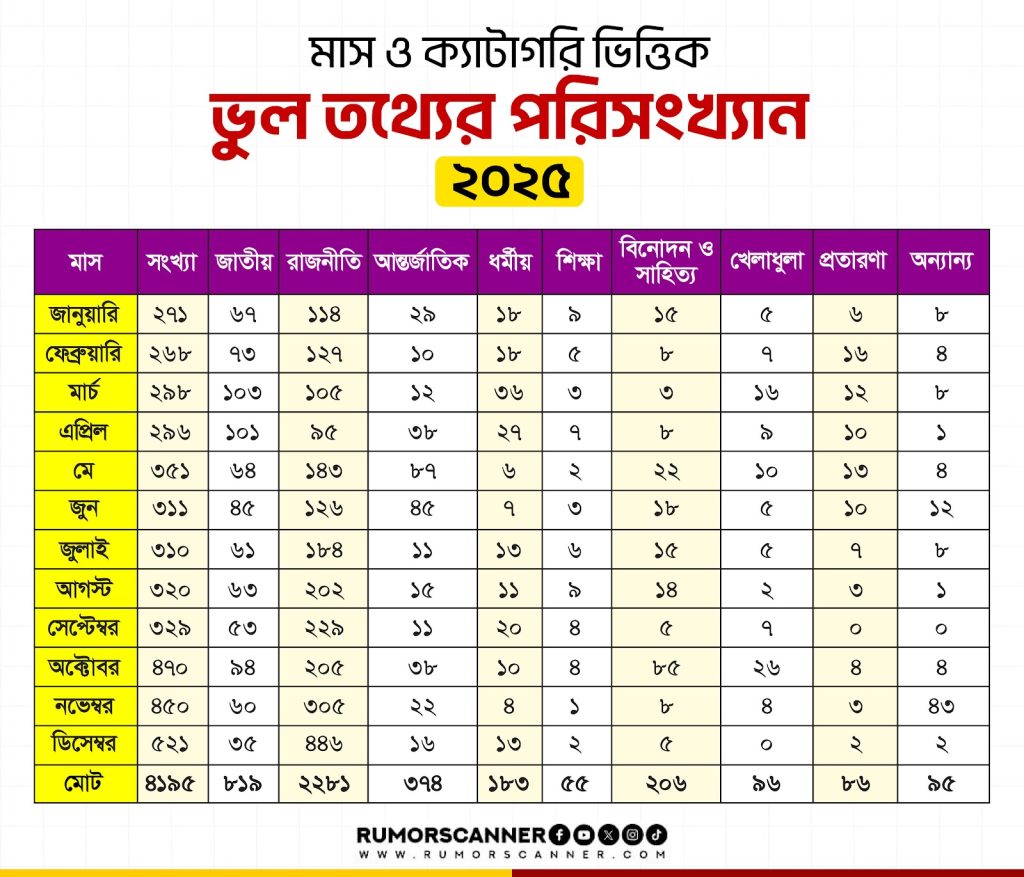
The number of national-level false claims stood at 819, the second highest, while 374 items were identified in international affairs.
A month-by-month analysis shows that misinformation increased significantly toward the end of the year, particularly in November and December. Although the number of false claims in religion, education, sports, entertainment, and literature was comparatively lower, they still contributed to social confusion. Fraud and other categories were also regularly present.
More misinformation in the third quarter
In the first quarter of 2025, a total of 837 false claims were identified, comparatively lower, indicating a relatively stable information environment at the start of the year. In the second quarter, the number rose to 958, reflecting a gradual increase in misinformation activity.
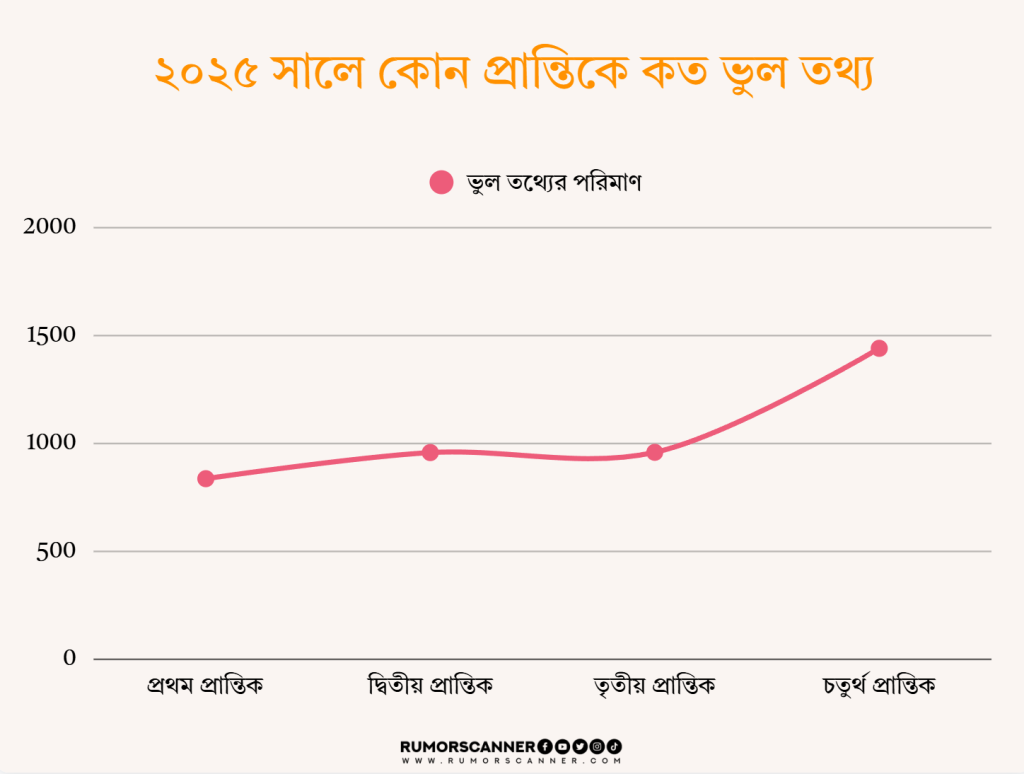
The third quarter saw a similar level, with 959 false claims, suggesting that while the spread of misinformation remained steady during the mid-year, it did not decline. The most alarming picture emerged in the fourth quarter, when the number suddenly surged to 1,441, significantly higher than in other quarters.
This increase in the fourth quarter was driven by political developments, election-related discussions, and major national and international issues.
More misinformation in favor of the Awami League, against BNP–Jamaat–NCP
Ahead of the parliamentary election, almost all political parties remained active in the political arena last year. On 12 May, the interim government issued a gazette banning the activities of the Awami League and all its affiliated, associate, and allied organizations. Earlier, a special meeting of the government’s advisory council decided to suspend the party’s activities until the completion of trials over the July–August killings. In November 2024, the government had declared the party’s student wing, Bangladesh Chhatra League, a banned organization.
Despite the ban, Awami League leaders and activists remained vocal online throughout the year, actively spreading old rally videos, AI-generated content, and issue-based misinformation.
An analysis of Rumor Scanner’s reports shows that the highest number of misinformation cases (966) involved the Awami League, its affiliated organizations, and its leaders and activists. Of the misinformation involving the party, nearly 93 percent created scope for a positive portrayal of the Awami League.
During this period, 273 false claims involved Sheikh Hasina, 88 percent of which presented her positively.
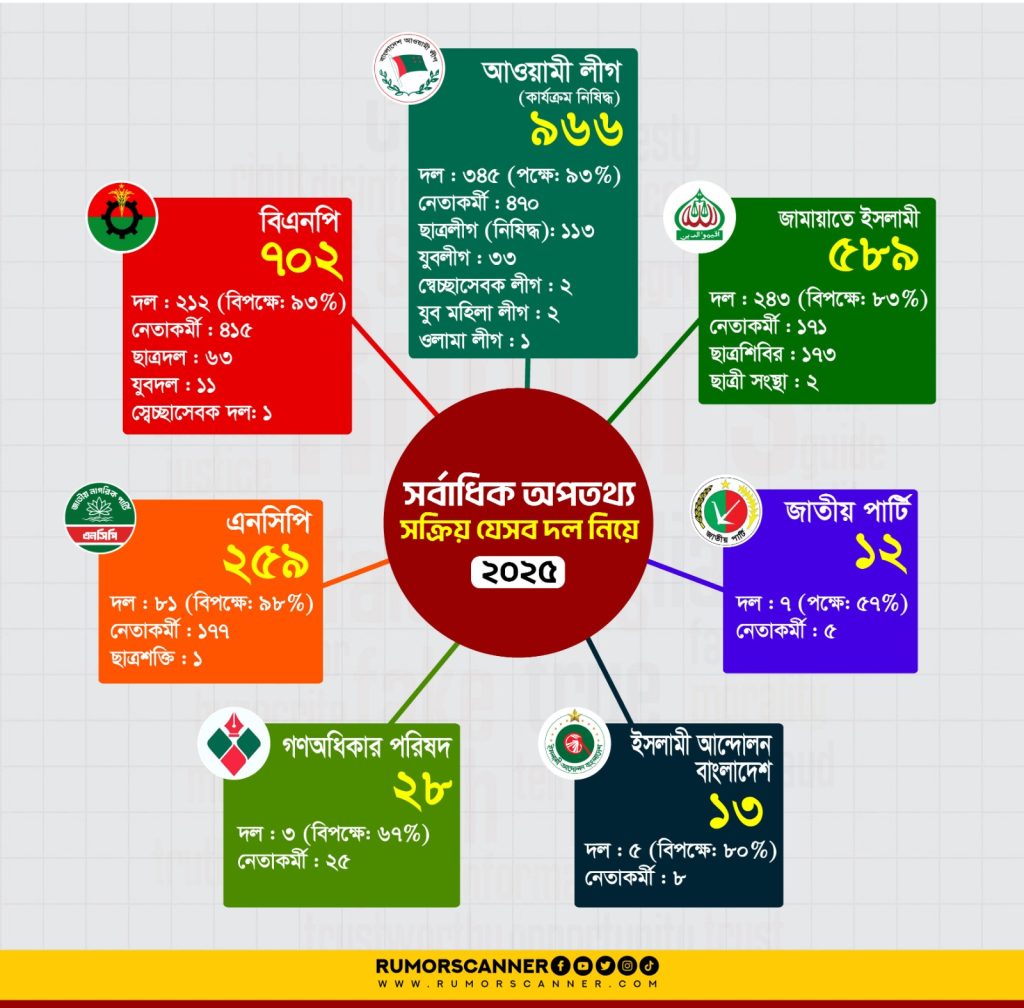
Among politically active parties, the Bangladesh Nationalist Party (BNP) was the most targeted by misinformation in 2025. Rumor Scanner identified 702 false claims involving BNP, its affiliated organizations, and leaders. Of the 212 false claims directly involving BNP as a party, nearly 93 percent carried a negative portrayal. In addition, 109 false claims involved BNP Chairperson Tarique Rahman, 66 percent of which were negative.
Bangladesh Jamaat-e-Islami also featured among parties with over five hundred misinformation cases. A total of 589 false claims involved the party, its affiliates, and leaders, with nearly 83 percent portraying the party negatively.
During this time, 51 false claims involved the party’s Ameer, Dr Shafiqur Rahman, 92 percent of which were negative.
Beyond these, misinformation involving the National Citizen Party, Islami Andolon Bangladesh, and Gono Odhikar Parishad was also predominantly negative in portrayal.
Persistent misinformation involving the interim government
The interim government led by Dr Muhammad Yunus has been in power for nearly one and a half years. Last year, Rumor Scanner identified 464 false claims involving the government and its advisers. Of these, 107 directly involved the government, with nearly 91 percent portraying it negatively.
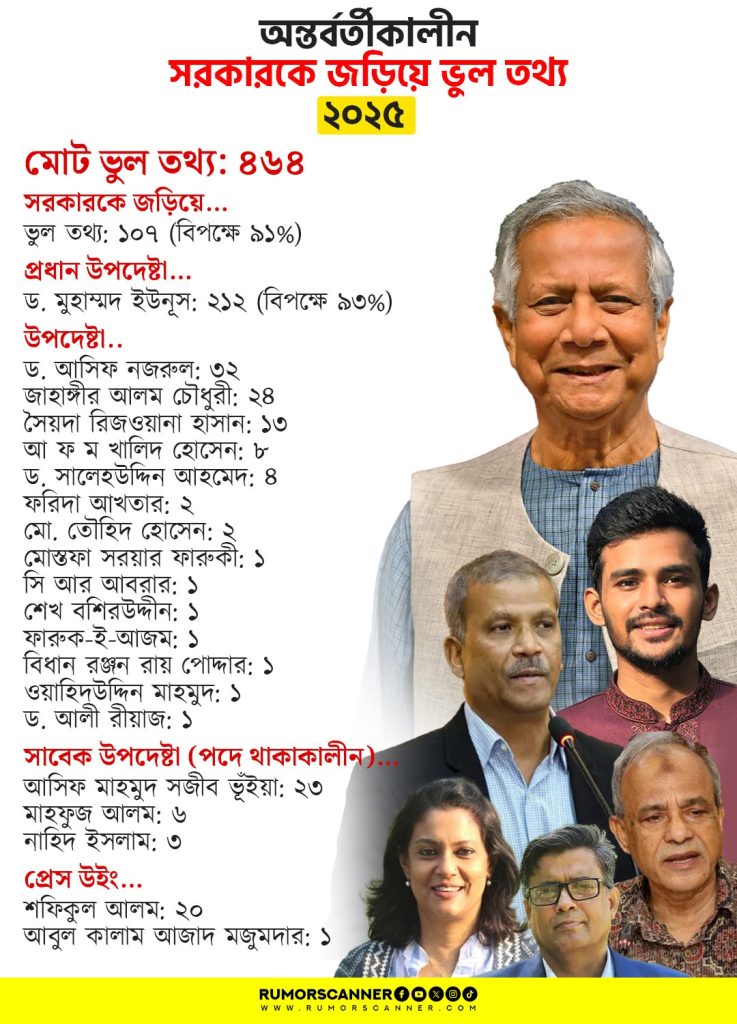
In addition, 212 false claims involved Dr Yunus himself, with nearly 93 percent presenting him negatively.
No sector was spared from misinformation
An analysis of Rumor Scanner’s 2025 reports shows that Sheikh Hasina was the most frequently targeted individual by misinformation last year. She was followed by Dr Muhammad Yunus. The third position was occupied by Osman Hadi, spokesperson of the Inqilab Mancha, who was murdered in December.
Within the political sphere, Sheikh Hasina and Osman Hadi ranked first and second respectively, followed by Tarique Rahman. In the national category, Dr Yunus topped the list, followed by government adviser Dr Asif Nazrul and the Chief Adviser’s Press Secretary Shafiqul Alam.
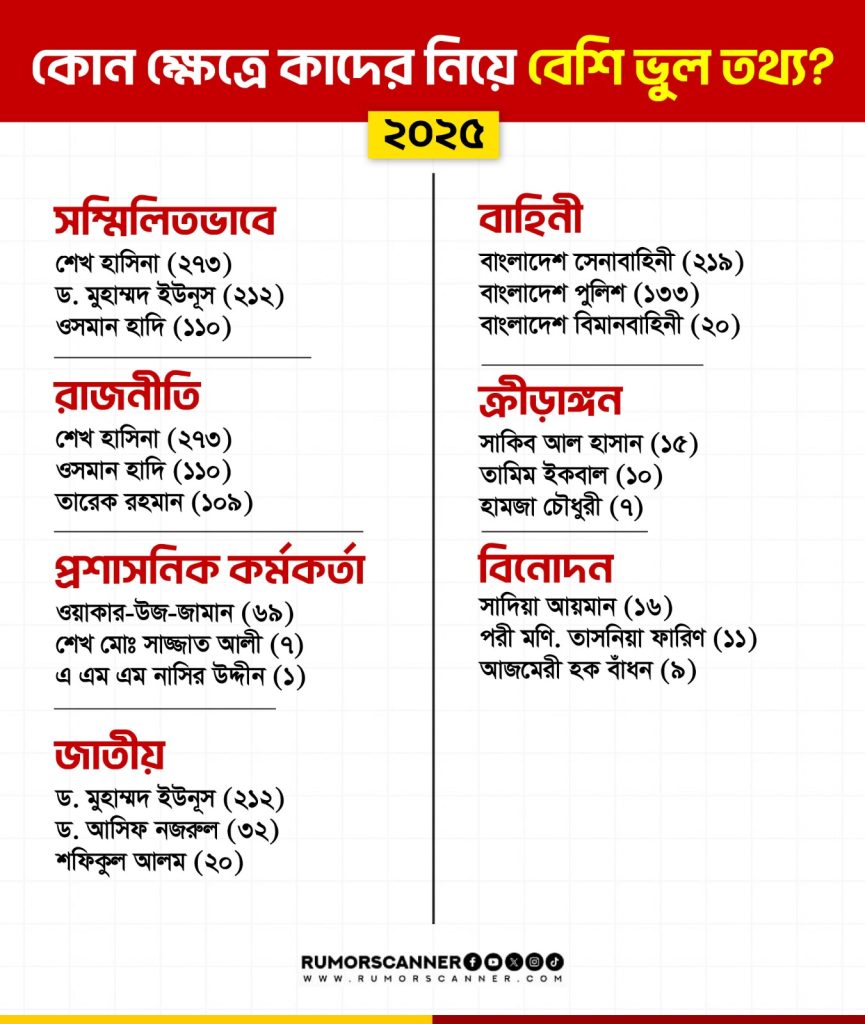
Rumor Scanner found evidence of 492 false claims involving armed and law enforcement agencies last year. Of these, the Bangladesh Army was involved in the highest number (219), marking an increase of nearly 126 percent from 2024.
A total of 69 false claims involved the current army chief General Waker-Uz-Zaman, reflecting an increase of nearly 263 percent.
Additionally, 20 false claims involved the Air Force (including 4 involving Air Chief Marshal Hasan Mahmud Khan), and 6 involved the Navy (including 4 involving Navy Chief Admiral M Nazmul Hasan).
Beyond this, 133 false claims involved the Bangladesh Police (an increase of nearly 166 percent), 2 involved Inspector General of Police Baharul Alam, 7 involved DMP Commissioner Sheikh Md Sazzat Ali, 9 involved the Rapid Action Battalion (RAB), 13 involved Border Guard Bangladesh (BGB), and 1 involved the Bangladesh Ansar and Village Defence Force.
Last year, Rumor Scanner identified 68 false claims in the sports arena. Analysis shows that Shakib Al Hasan was the most affected athlete, followed by Tamim Iqbal and Hamza Choudhury.
Rumors and ambiguity are constant in the entertainment world. Amid this, Rumor Scanner identified 170 false claims involving entertainment and literature in 2025. The most affected was small-screen actress Sadia Ayman, followed jointly by actress Porimoni and actress Tasnima Farin. The third position was held by actress Azmeri Haque Badhon.
Misinformation accompanied various issues
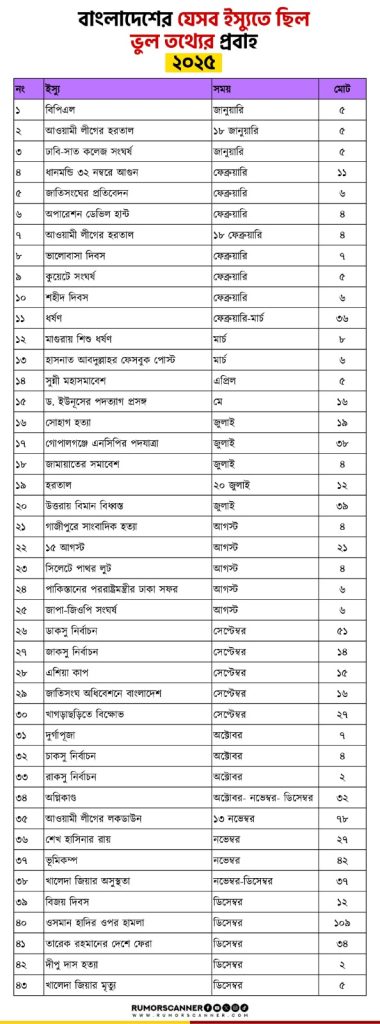
Throughout the year, the internet remained abuzz with various issues. Of the 43 issues recorded by Rumor Scanner, 20 were political. Among them, the December shooting and subsequent death of Osman Hadi saw the highest spread of misinformation. Other issues with over fifty false claims included the Awami League lockdown on 13 November and the DUCSU election in September.
Beyond politics, misinformation also spread around national affairs, natural disasters, sports, and religious issues. Overall, Rumor Scanner identified 796 false claims across 43 issues last year.
Indians behind communal misinformation
Communal misinformation has become a major concern in religious matters. The spread of communal false claims centering on Bangladesh has been under discussion for several months. In 2025, Rumor Scanner identified 165 communal misinformation cases. In 94 of these, evidence showed dissemination from Indian-identified social media accounts and pages.
Beyond communal misinformation, Indian media outlets were also found to regularly spread false information involving Bangladesh. In 2025, Rumor Scanner identified 36 news reports in Indian media that contained misinformation about Bangladesh.
Concerns over AI deepfakes and fake media photocards
Following the trend of 2024, the spread of misinformation through artificial intelligence and deepfake technology was particularly notable last year. A total of 606 misinformation cases were identified, including 86 deepfake videos, reflecting a 409 percent increase compared to the previous year.
In 2025, the use of media names, logos, headlines, and fake photocards involved 75 domestic and international media outlets in 687 incidents, spreading 744 false claims. This means that, on average, more than two false claims per day attempted to mislead people by involving media brands. In 2024, the number was 505.
The outlets most frequently misused were Daily Amar Desh (106), Jamuna TV (89), and Daily Kaler Kantho (78).
Methodology
These statistics are based on reports published on the Rumor Scanner website from January to December 2025. For statistical purposes, data from each report over the past 12 months were systematically collected and documented, then analyzed. The findings were compared with data from 2024 and subsequently presented through infographics and written reports.