
Written by The Banking Post
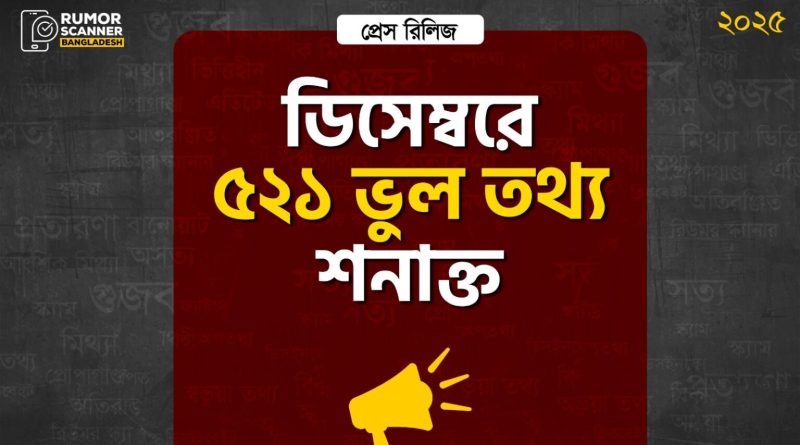
In December (2025), Bangladesh’s fact-checking organization Rumor Scanner identified 521 pieces of misinformation circulating on the internet. This is the highest number of misinformation cases detected in a single month in the history of Rumor Scanner. These false claims were fact-checked and published through 447 reports on the Rumor Scanner website.
Analysis shows that in December, political issues accounted for the highest number of misinformation cases (446), representing nearly 86 percent of the total. In addition, 35 cases involved national issues, 5 entertainment, 13 religious, 16 international, 2 each related to education and fraud, and 2 in other categories. Alongside regular fact-checks, one research report, three fact stories, and one fact file were published in December.
An analysis of the misinformation identified in December shows that information-based falsehoods were the most prevalent, totaling 287 cases. This was followed by video-based misinformation (136) and image-based misinformation (98). Among the identified cases, 388 were classified as false, 89 as distorted, 41 as misleading, 2 as partially false, and 1 as partially true.
Further analysis shows that during this period, 408 misinformation cases involved men, while 168 involved women.
At the same time, misinformation cases were divided into four age groups. The analysis indicates that youth (aged 18–35) were involved in the highest number of cases, totaling 273.
In addition, 8 cases involved children (aged 0–17), 123 involved middle-aged individuals (aged 36–59), and 268 involved senior citizens (aged 60 and above).
By platform, Facebook spread the highest amount of misinformation last month, with 475 cases. This was followed by Instagram (136), TikTok (96), YouTube (57), X (42), Threads (at least 16), and LinkedIn (2). The list of misinformation spread also included national media outlets. Rumor Scanner found evidence of misinformation being published in 20 cases across several Bangladeshi media outlets. During the same period, two instances of misinformation involving Bangladesh were identified in Indian media.
The spread of communal misinformation centering on Bangladesh has been under discussion for several months. In December, Rumor Scanner identified six such communal misinformation cases. In five of these, evidence showed dissemination from Indian-identified social media accounts and pages.
Observations by the Rumor Scanner team show that in December, seven pieces of misinformation involved the current interim government. To understand the nature of these false claims, Rumor Scanner categorized them into two groups. Misinformation favoring the government was considered positive, while that going against it was considered negative. The analysis found that nearly 86 percent of these cases portrayed the government negatively.
In December, 15 pieces of misinformation involved Dr Muhammad Yunus, the Chief Adviser of the interim government. All of these portrayed him negatively.
Discussions surrounding the 13th National Parliamentary Election are widespread. Over the past several months, misinformation related to the election has increased. In December, 110 election-related misinformation cases were identified.
An analysis of Rumor Scanner’s December fact-checks shows that among politically active parties, the Bangladesh Nationalist Party (BNP), its affiliated organizations, and leaders and activists were involved in the highest number of misinformation cases (214). Of these, 33 involved BNP as a party, with nearly 88 percent creating scope for a negative portrayal. In addition, 68 misinformation cases involved the party’s acting chairperson Tarique Rahman, 66 percent of which portrayed him negatively. During this period, one misinformation case involved Chhatra Dal.
After BNP, the Bangladesh Jamaat-e-Islami, its affiliated organizations, and leaders and activists were involved in the second-highest number of misinformation cases (175). Of these, 62 involved Jamaat as a party, with nearly 84 percent creating scope for a negative portrayal. During this time, 21 misinformation cases involved the party’s Ameer Dr Shafiqur Rahman, with about 90 percent portraying him negatively.
During this period, 32 misinformation cases involved Bangladesh Islami Chhatra Shibir, the student wing of Jamaat.
In addition, in December, Rumor Scanner identified 38 misinformation cases involving the National Citizen Party (NCP) and its leaders and activists. Of these, 8 involved the party as a whole, all of which created scope for a negative portrayal. During this time, five misinformation cases involved the party’s convener Nahid Islam, all of which portrayed him negatively.
In December, 154 misinformation cases involved the banned Bangladesh Awami League, its affiliated and allied organizations, and its leaders and activists. Of these, 39 involved the Awami League as a party, with nearly 87 percent creating scope for a positive portrayal of the party. During this period, 52 misinformation cases involved the party’s president Sheikh Hasina, about 94 percent of which were positive. In addition, last month 19 misinformation cases involved the banned student organization Bangladesh Chhatra League, and 4 involved Jubo League.
State forces were also not spared from the spread of misinformation. In December, Rumor Scanner identified 18 misinformation cases involving the Bangladesh Army, including 4 involving Army Chief General Waker-Uz-Zaman. In addition, 19 cases involved the Bangladesh Police, and 2 cases each involved the Rapid Action Battalion (RAB) and Border Guard Bangladesh (BGB).
An analysis of the misinformation identified in December shows that 103 cases involved fake content created using artificial intelligence, including 10 deepfake items.
In December, misinformation spread around six events or issues. The highest number (109) was related to the murder of Sharif Osman Hadi, spokesperson of Inqilab Mancha. Other issues included Tarique Rahman’s return to the country (34), Khaleda Zia’s illness (20), Victory Day (12), rumors of Khaleda Zia’s death (5), and the murder of Dipu Das in Mymensingh (2).
The use of media names, logos, headlines, and fake or fabricated photocards to spread misinformation is once again on the rise. In December, this method was used in 159 incidents, involving 32 domestic and international media outlets, to spread 178 pieces of misinformation.